Your customers are already on WhatsApp. Here is why turning those conversations into a real shop saves time, wins sales and keeps customers loyal, and how to do it without drowning in messages.
"Do you still have cassava?", "Put two bags of rice aside for me, I'll come by tonight", "Do you deliver to Créteil?". If you run an Afro-Caribbean grocery or restaurant in France or elsewhere in Europe, you already get these messages every day on WhatsApp. Your customers did not wait for a website to order: they write where they already write to their family, back home and here.
The problem is not WhatsApp. It is handling everything by hand: replying between two customers at the till, checking stock, remembering who ordered what, forgetting an order on a busy Saturday. WhatsApp commerce means turning these conversations into a real, organised shop, without losing what your customers like: simplicity and direct contact.
In our communities, WhatsApp is the everyday tool: family groups, associations, savings clubs (tontines), neighbourhood or church groups. Many of your customers open it more often than their e-mail and will never install one more app to do their shopping.
Selling on WhatsApp means going to them rather than asking them to come to you. No account to create, no password, no website to discover: they write to your number, as they already do.
An order taken "by hand" on WhatsApp is often ten messages: the customer asks if the product is in, you check, you give the price, they add another one, they ask about delivery… and then everything has to be copied out. Multiply that by twenty customers before a holiday, and the shop grinds to a halt.
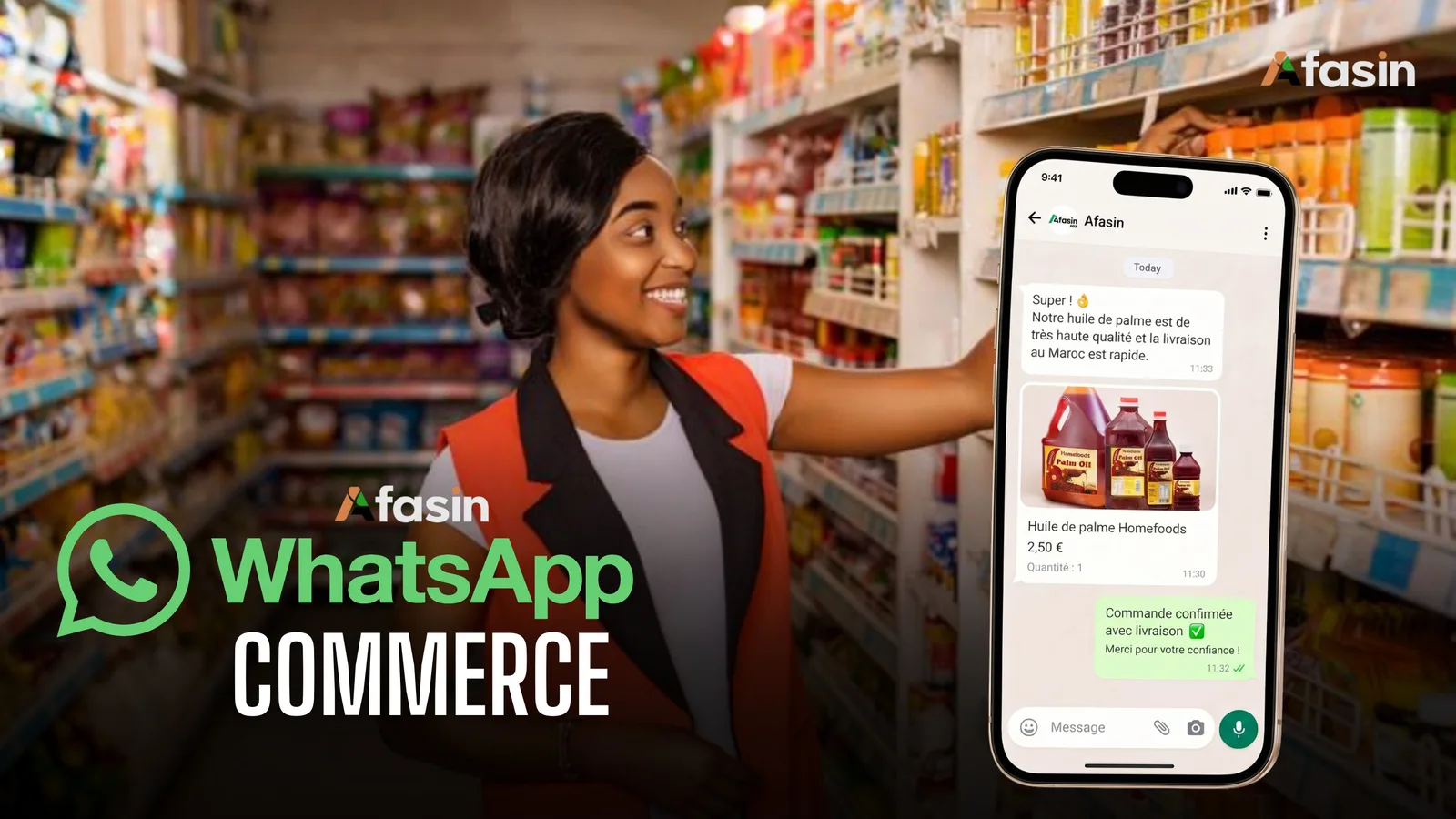
With a WhatsApp shop, the customer does that work themselves: they search for the product, see the photo and the price, add it to the basket with buttons, choose collection or delivery. You receive a complete order, ready to prepare.
Afro-Caribbean retail is built on trust and relationships. WhatsApp keeps that link: the customer knows they are talking to their grocery or their restaurant, not to an anonymous platform. They are told when their order is accepted, ready or out for delivery, and they do not need to call you to find out where it is.
A customer who ordered easily once will order again the following week, instead of going to the supermarket or to a competitor who replies faster.
Many of your customers work unusual hours. They think about their shopping in the evening, on public transport, on Sunday. A WhatsApp shop takes the order at any time; you handle it when you open. These are sales you were not making before.
The big delivery platforms take a large share of every order, which weighs heavily on margins that are already tight in food retail. An order received on your WhatsApp stays a sale for your shop: the customer pays you directly, on collection or on delivery.
AFASIN Pro, ACAC's till software for Afro-Caribbean shops, includes a WhatsApp shop linked directly to your till and your stock:
On top of the shop, you and your team can receive the shop's alerts on WhatsApp: a new online order, a purchase order suggested for a supplier, stock or the day's sales, with buttons to reply without opening the computer.
An order taken on WhatsApp is still a distance sale: product information (price, allergens, quantity…) must be available before purchase, and some rules apply even for collection in store. We cover them in our article Selling Afro-Caribbean products online before the holidays: the rules to follow.
On the WhatsApp side, also remember that a business can only message a customer freely within 24 hours of the customer's last message: that is why a WhatsApp shop works best when the customer writes first. So no unsolicited advertising messages: let your customers come to you.
Your customers already order on WhatsApp. The question is not whether to be there, but whether you keep handling everything by hand or turn it into a real shop, linked to your till and your stock. Less time on the phone, fewer mistakes, more orders and loyal customers: that is what WhatsApp commerce brings to our shops.
The WhatsApp shop is available from AFASIN Pro's free plan, with 20 credits to try it; the Adhérent plan (€5.90 a month) includes 150 WhatsApp/AI credits a month. See the plans or register your shop for free, and the ACAC team will help you switch it on.
Till, stock, wholesale prices and online sales, in one app.