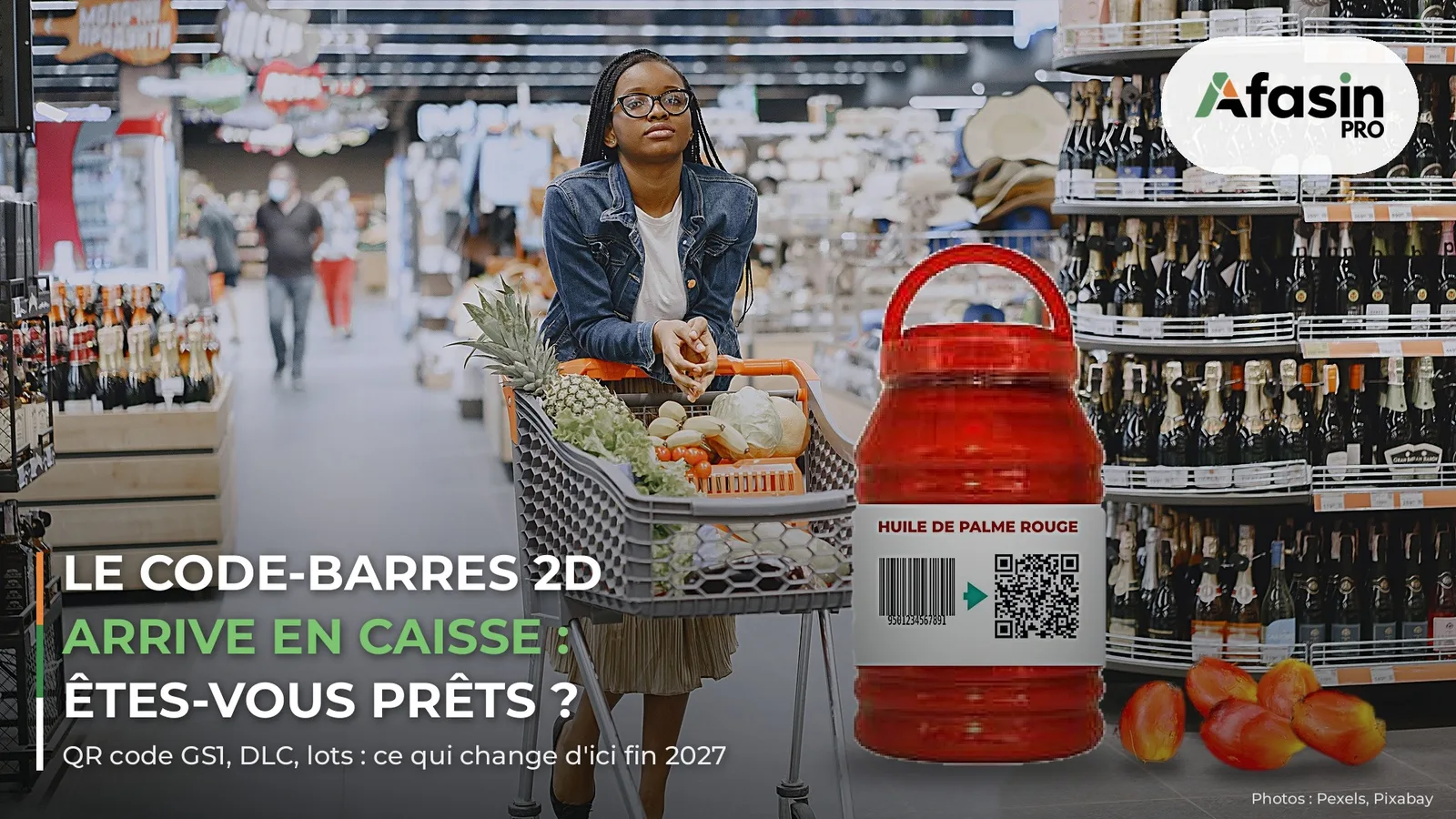
Carrefour, Tesco, dm, Woolworths: big retailers are moving to the GS1 QR code, which can carry a product's use-by date and lot. The global goal: tills able to read it by the end of 2027. What it means for an Afro-Caribbean grocery, and how to get ready without spending too early.
For more than fifty years, the classic barcode (EAN) has told the till only one thing: which product is on the belt. It knows nothing about the use-by date, the lot or the origin. That is changing. Across Europe, big retailers are testing a new two-dimensional code, a QR code built to GS1 standards, the organisation that already manages the barcodes you scan every day.
For an Afro-Caribbean grocery, this is not just a supermarket matter. Your suppliers will gradually print these codes on their packaging, and your till will need to read them. Here is what you need to know, without jargon.
What is happening now
- In France, Carrefour added a GS1 QR code to 50 of its own-brand products in May 2026, after a first test on its wines. Customers who scan it with their phone get the product sheet; the retailer says more roll-outs are coming.
- In the UK, Tesco decided, after two years of pilots, to replace the classic barcode with a QR code on its own-label range.
- In Germany, dm has been testing since March 2026, in some of its stores, how its tills read 2D codes using "imager" scanners that read the code like a photo. A national roll-out has not been decided yet.
- In Australia, Woolworths has used 2D codes since 2019 on fresh meat and poultry. According to the case study published by GS1, the retailer cut food waste by up to 40% and improved productivity in date management by up to 21% on products fully switched to 2D.
All of this is part of a global goal called "Sunrise 2027": by the end of 2027, shop tills should be able to read these 2D codes. It is not a legal obligation, and the classic barcode will not vanish overnight: the industry expects a five-to-ten-year transition during which both will appear on packaging.
Why it matters for a grocery
A classic barcode holds 13 digits. A GS1 QR code can hold thousands of characters: the product code, but also the use-by or best-before date, the lot number and a link to the product sheet. In practice, a till that can read it could:
- block the sale of an expired product, instead of relying on a visual check on the shelf;
- apply an automatic discount to a product close to its date, for example a yoghurt or meat to be eaten by the next day;
- find a recalled lot immediately: on the day of a recall, you know which items sold or in stock are affected.
In our shops, where fresh and frozen goods, fish, halal meat and short-life imported products weigh heavily in losses, this is exactly where part of the lost margin hides. Every product thrown away is a purchase paid for and never sold.
Limits to keep in mind
- Your suppliers set the pace. The QR code will only appear on your products if the manufacturer or importer prints it. Big brands will go first; small producers in Africa and the Caribbean will follow more slowly.
- Not every scanner reads QR codes. Older "laser" scanners only read classic barcodes. You need a "2D" or "imager" scanner.
- The till software must understand the content too. Reading the code is not enough: the till must be able to extract the date and the lot.
How to get ready without spending too early
- Check your scanner. Look at its technical sheet: if it says "2D", "imager" or "QR", your hardware is already ready. If not, choose a 2D model at the next replacement: the price gap is small today.
- Start tracking dates now. You do not need the QR code to manage use-by dates. In Afasin Pro, you can already enter your products' expiry dates and follow the list of expired products to act before it is too late.
- Set a markdown rule. For example: 30% off two days before the date, 50% off the day before. Display it clearly on the shelf: your customers will learn to look for these deals.
- Ask your suppliers whether they plan to print the GS1 QR code on their packaging, and whether they can show the lot and date on invoices or delivery notes. This helps right away, especially during a recall.
- Think about your own labels too. If you repack bulk goods (spices, flours, dried fish), a simple QR code linking to the product sheet reassures customers. The full GS1 format requires a product code registered with GS1: worth considering if you launch your own brand.
Our view (ACAC / AFASIN)
The 2D barcode is good news for small shops: it automates a task, monitoring dates, that supermarkets do with whole teams and that the shopkeeper does alone, often in the evening. But the real saving will not come from the QR code itself: it comes from the habit of tracking dates and marking down in time. Those who build that habit today will be ready when their suppliers switch to 2D.
Does your till already read QR codes? Have your suppliers mentioned them? Share your experience with ACAC: your feedback helps the whole shopkeeper community get organised.
Sources
Cover visual: Afasin Pro. Photos: supermarket aisle Pexels (Pexels licence), palm fruit Pixabay (Pixabay licence).