Rice, palm oil, spices, canned goods from Africa or the Caribbean: before stocking up for the holidays, check that every product shows the mandatory information in French. Our practical checklist.
In an Afro-Caribbean grocery store, much of the shelf comes from far away: gari from Benin, attiéké from Côte d'Ivoire, Caribbean hot pepper, Nigerian sauces, Ghanaian canned goods, Cameroonian flours. Many of these products arrive in packaging designed for their home market, often in English or Portuguese. In France, however, a prepacked food sold to consumers must display its mandatory information at least in French. With the holidays approaching, when orders rise and in-store inspections remain possible, now is a good time to check.
The main framework is EU Regulation No 1169/2011, known as "INCO", on food information to consumers. In France, the DGCCRF (the consumer protection authority) states in its practical guide (updated in July 2026) that mandatory information must be visible, legible and written at least in French. The French law of 4 August 1994 on the use of the French language (the "Toubon law") points the same way for product names and presentation.
A point that is often misunderstood is responsibility. The label is the responsibility of the operator under whose name the product is sold, and that operator must be established in the European Union. When the manufacturer is outside the EU, in practice the importer carries that responsibility. And if you import a container or parcels directly from Africa or the Caribbean, without going through a wholesaler, the importer is you.
For legibility, the minimum character height is 1.2 mm, reduced to 0.9 mm for small packages whose largest surface is under 80 cm².
For non-prepacked products (fruit and vegetables, yams, plantains, fish, meat at the counter, products packed on request), no full label is needed, but a sign next to the product must show at least the name and any allergens. Origin is required for fruit, vegetables and meat and, since 2025, for some loose products such as dried fruit and shelled nuts.
French labelling is not just one more administrative burden: it is what allows an allergic customer, a newcomer to our cuisines or a busy parent to trust our products. Our shops are winning customers beyond the diaspora; a clear French label is one of the simplest ways to keep them.
The real lever is collective. A single grocery has little weight against an importer that does not supply French labels. Several shops making the same demand do. That is the point of ACAC's work with the suppliers tracked in the AFASIN Pro price comparator: favour those that deliver compliant products, and say so. If one of your suppliers consistently refuses to provide information in French, let the association know.
This article is general information, not legal advice. If in doubt about a specific product, contact your local DDPP (consumer protection office) or a legal professional.
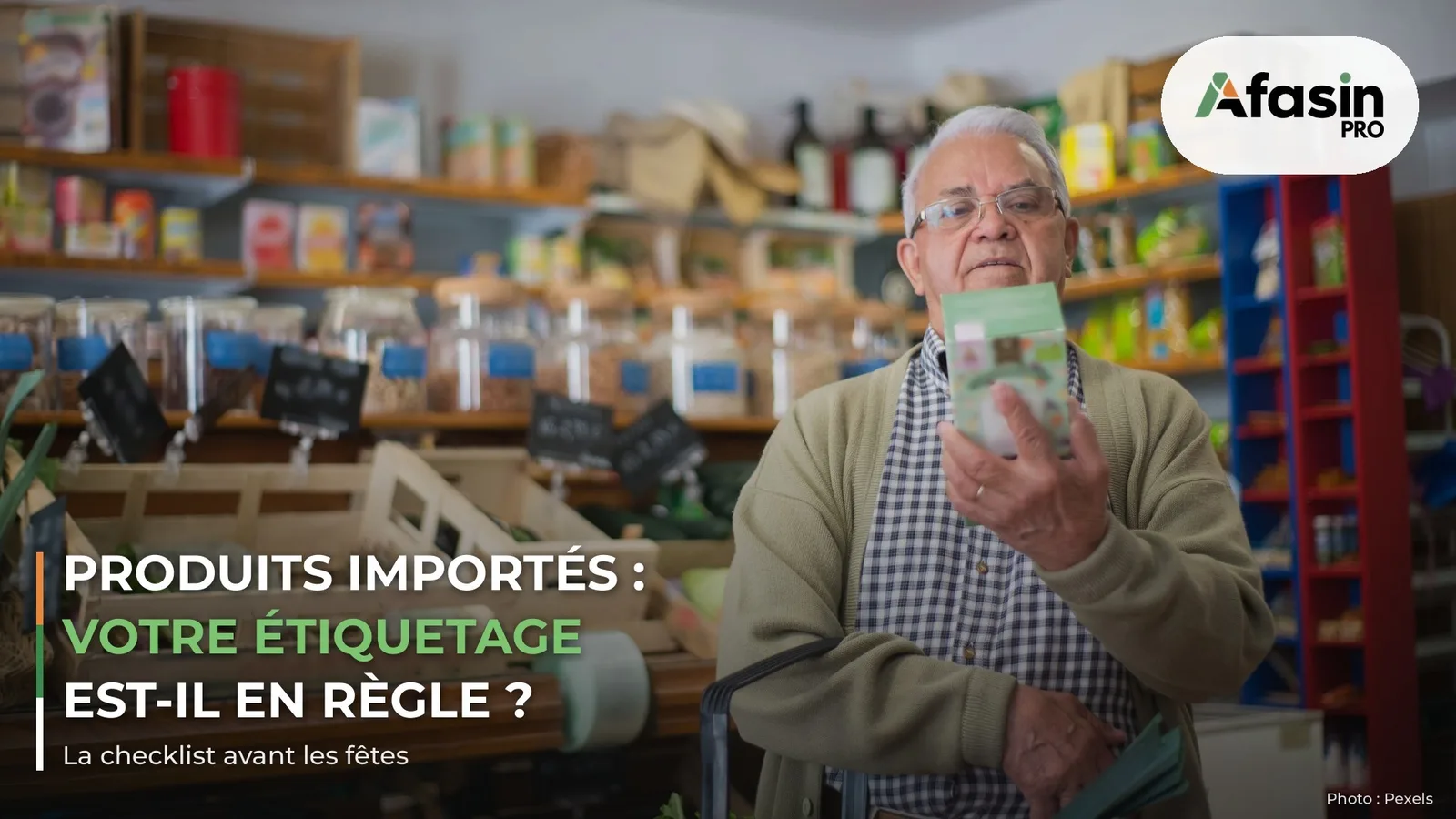
Cover photo: Pexels (Pexels licence).
Till, stock, wholesale prices and online sales, in one app.