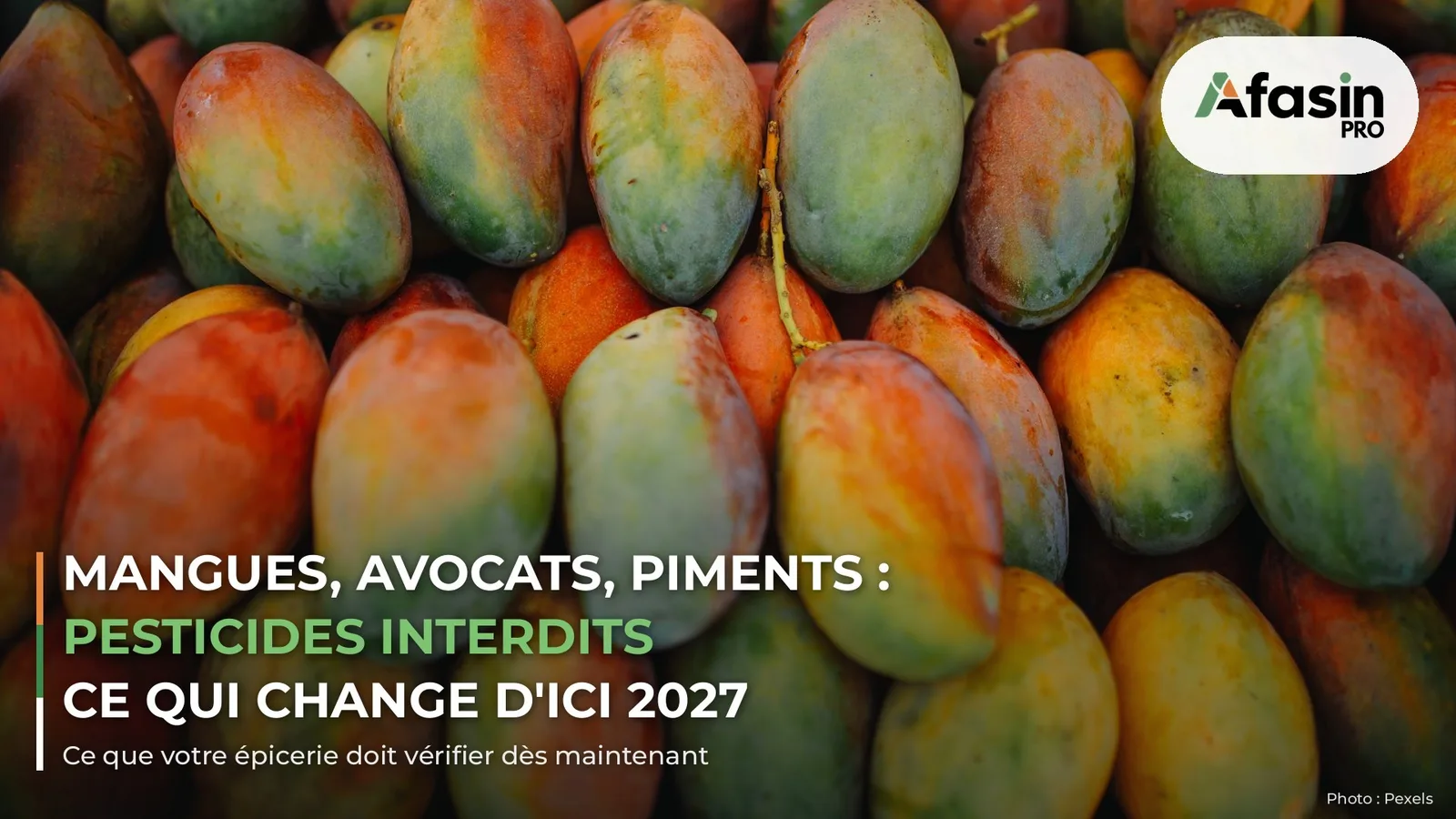
Since February 2026, France has blocked imported foods with traces of five pesticides banned in the EU, and new EU limits apply from 29 January 2027. What this means for your purchases of mangoes, avocados, papayas or peppers, with a checklist.
Mangoes, avocados, papayas, peppers, sweet potatoes, citrus: these products are at the heart of many Afro-Caribbean grocery shops. Since early 2026, France has applied a stricter rule than the rest of the European Union on residues of certain pesticides in food from non-EU countries. And a new EU step arrives on 29 January 2027. With holiday volumes of tropical fruit about to rise, now is the right time to take stock.
An order (arrêté) dated 5 January 2026, published in the Journal officiel on 7 January, suspends the import and placing on the French market, free or paid, of food from third countries that contains quantifiable residues of five substances banned in the EU:
The measure covers raw and processed products. It applies to goods acquired after 8 February 2026 (stock bought before that date remained under the usual EU limits). The thresholds match the quantification limits of official labs, for example 0.01 mg/kg for carbendazim and 0.02 mg/kg for mancozeb. In practice, any measurable trace is enough.
The order ends once equivalent EU measures are in place, and at the latest one year after entry into force, i.e. early January 2027. An extension or replacement remains possible: keep an eye on Légifrance and the Ministry of Agriculture.
The European Commission adopted Regulation (EU) 2026/1546 on 8 July 2026, published in the EU Official Journal on 9 July. It lowers the maximum residue levels (MRLs) of three of the five substances targeted by France, benomyl, carbendazim and thiophanate-methyl, down to detection limits.
These new MRLs apply across the EU from 29 January 2027. Products placed on the market before that date and compliant with the old limits can in principle stay on sale. But according to the AGRINFO platform, one exception covers products we sell: mangoes, papayas, oranges and grapefruits exceeding the new carbendazim limits can no longer be sold after that date, even if bought earlier.
For mancozeb and glufosinate there is no equivalent EU measure yet, so the French rule is what makes the difference.
The Ministry's FAQ is aimed first at importers and operators placing products on the market. But the suspension also covers resale and distribution. If you import yourself (containers, grouped parcels, direct purchases from an exporter), you are on the front line. If you buy from a wholesaler in France, they carry most of the checks, but a non-compliant product on your shelves still has to be withdrawn.
The good news: this is an obligation of means ("reasonable due diligence"), not a duty to test every batch. You must be able to show you did what was needed: know the origin, assess the risk, obtain guarantees, and test when the risk justifies it. According to the FAQ, the written commitment should come from the first exporter in the third country. If a supplier refuses, keep a record of your requests and their refusal, and step up your own checks.
These rules don't target our shops, but they hit our flagship products. The main risk isn't the fine: it's the stock-out, the blocked batch or the supplier who can't keep up. Shops that can prove where their fruit and vegetables come from will reassure customers and negotiate better with wholesalers.
For ACAC, the answer is collective: share among members the wholesalers that provide serious attestations, pool requests to exporters and, if needed, testing costs. Tell us which products are causing you trouble: that is how we can take your questions to suppliers and the authorities.
This article is general information, not legal advice. Always check the texts in force or consult a professional before making decisions.
Cover photo: Pexels (Pexels licence).
Till, stock, wholesale prices and online sales, in one app.